Day 19 – Wednesday 27 May
We have struck up a bit of a rapport with the breakfast staff which is lovely to have the human connection with the place you are in. Sometimes it feels like we are a bit alien, as there are not many other foreign tourists in the same places. Perhaps it is because we are not on a tour? There are plenty of people out and about at the sites, but they appear Turkish and native speakers.
Adding to that feeling of being alien is that we do not speak or read the language. It is not even remotely possible to guess what the work may be as the language is quite unique and not phonetical as we know it. This makes things hard work when navigating or trying to work out metro’s etc. There is also a notable lack of English signage which I understand and do not expect a country to be colonised. However, when a country relies heavily on tourists, English is the most universally used language and other European countries seem to adopt it as a second language to assist.
I wonder if it is deliberate so that one then uses tour guides etc? They block things like Booking.com, and many overseas e-sim so that you use local.
On that note, the e-sim work if you activate them before you arrive, which we did. We have Airalo, and it has been great except we cannot top it up, so have had to be economical with the data on the iPad. My roaming on Spark is working just fine, but more expensive than an e-sim.
We had a lot of debate about which other key tourist sites to visit – such as Hagia Sophia and the Topkapi palace. We have decided not to go to the mosque as we have been to a few other free ones on our walks and feel that whilst it is would be interesting historically and architecturally, it is not worth the entrance fee for us. The palace is $100nzd each for entry. Seriously. The discussion was very considered and we chose to go, hoping it would be interesting and stimulating.
By the time we got there the sun was well and truely high in the sky. Topkapi is situated on the peninsula of the Golden horn, and is a symbol of the wealth and magnitude of the Ottoman Empire for 400 years rule. It is near the old town areas where the Basilica, Hagia Sophia and Blue Mosque are.
Feeling more confident with our navigation of the public transport we walked about 2km mostly downhill to the tram station and got the tram to the closest stop. The tram was fairly full, but we got a seat part of the way there. The ride wasn’t long, about 10 minutes.
The next challenge was to identify where exactly the palace was, as it is surrounded by a large palace park which is free, and is also now a museum. We were not sure if there was more than one museum in the area, and with the lack of signage it was a bit tricky. There were booths for a museum outside the park, and also another single almost portable booth with a man selling tickets for the palace for 3,000 tky each.
We didn’t feel he was legit, so took some time to log on to the device and see what the official site said. The tickets price there was 2750 tky each and booths at the palace entry. Not a lot of difference once converted, but we were worried we could get to the destination and something be not quite correct. We figured to walk through the park as lots were heading that way, vs. a bit of a hill where there was a steady stream of people.k
Seems we took the wrong route, but no problem as we appreciated the shade of the tall trees and a toilet opportunity. We circled back to the entry area and walked up the paved slope to where we figured the palace was. First stop was a security check, then you entered another garden courtyard area with differing signs directing to the ticket booths. The logical place was blocked with a rope, and a man indicating to go to another area.
We followed the crowd and queued in the hot around 28-30 degree sun for about 20 minutes and then heard a big kerfuffle at a stand with someone speaking in very animated Turkish. Then a Turkish lady who spoke English in front of us, turned around and advised us we were in a queue that was for Turkish nationals only. Great.
We split off from that queue and went in the direction indicated to another queue. That line of people weaved like a full bellied snake toward about 5 booths of bored looking ticket staff. Everyone was melting. We had our hats on and just went into that zone where you tried not to think about how hot it was, whilst your legs swelled and sweat trickled down your face and back.
Children wailed with boredom and heat whilst ill equipped parents tried to console. I think the public holiday must have been making the crowds worse. I could not figure out why a family would venture out on such a day to something that would not interest children. The park full of tall shade providing trees I understand would be one of the few green spaces in the city and a welcome respite. But the palace with its heat reflecting stone and uneven walking surfaces was to prove me right judging by the regular wailing from the little people.
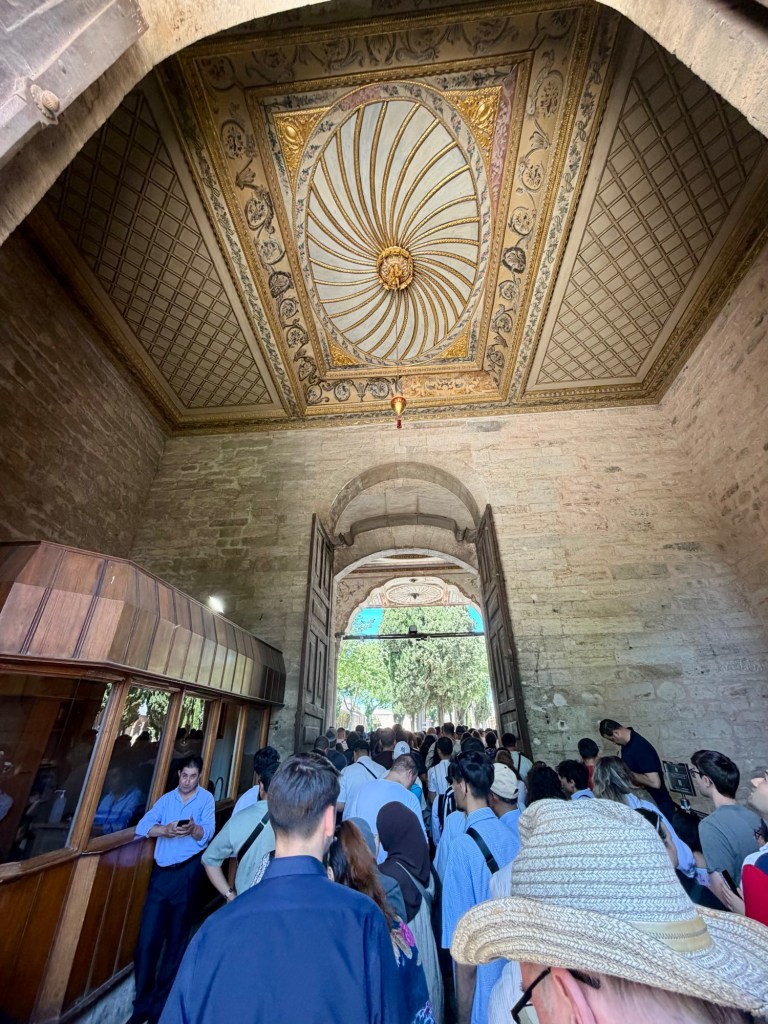
Once we got our tickets we had to queue again to wait until there was a time and distance space between our large group and the previous. I was really starting to question the ‘is it worth it’ for my $100…. Finally we got through the gates and entered the ‘second’ courtyard. I think that getting there and inside took nearly 2hrs from the time we left home. We only had about 4 hours left to see everything before closing time which seems a lot but the palace covers a very large area and we wanted to see the harem quarters (including living and family quarters) the relic area, treasury and armoury.
Topkapi palace was built in the 1400’s and occupied until around 1865 when a newer European palace was built. The architecture is organised by 4 courtyards, including the business quarters, the private quarters, and terraced gardens.
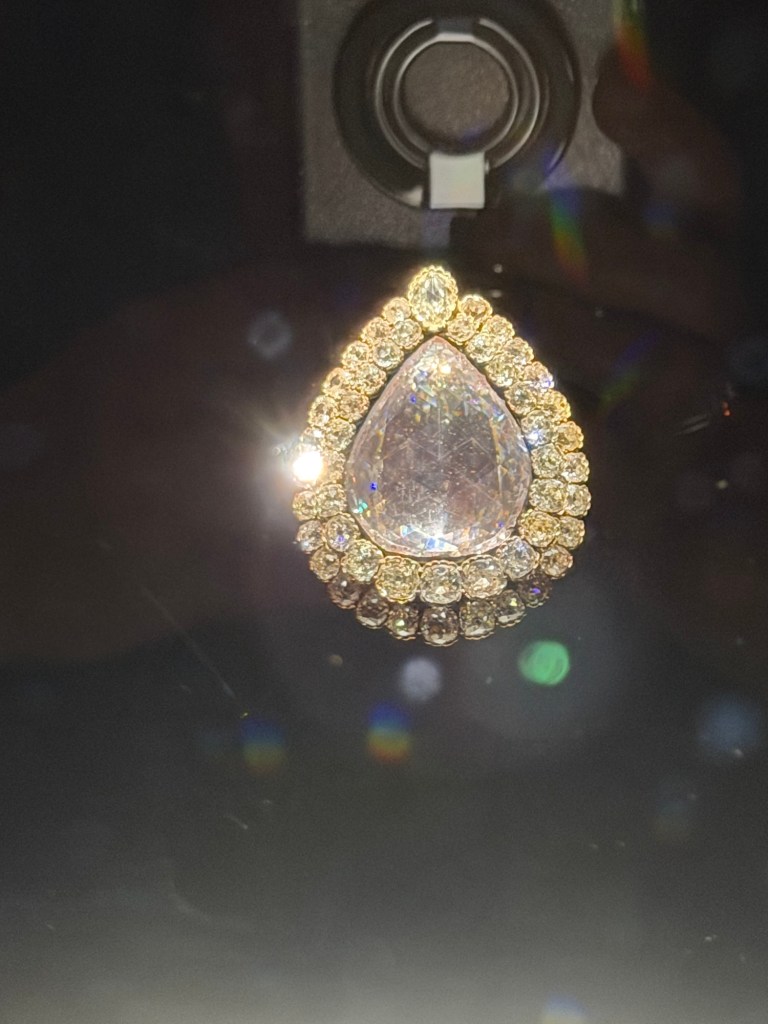
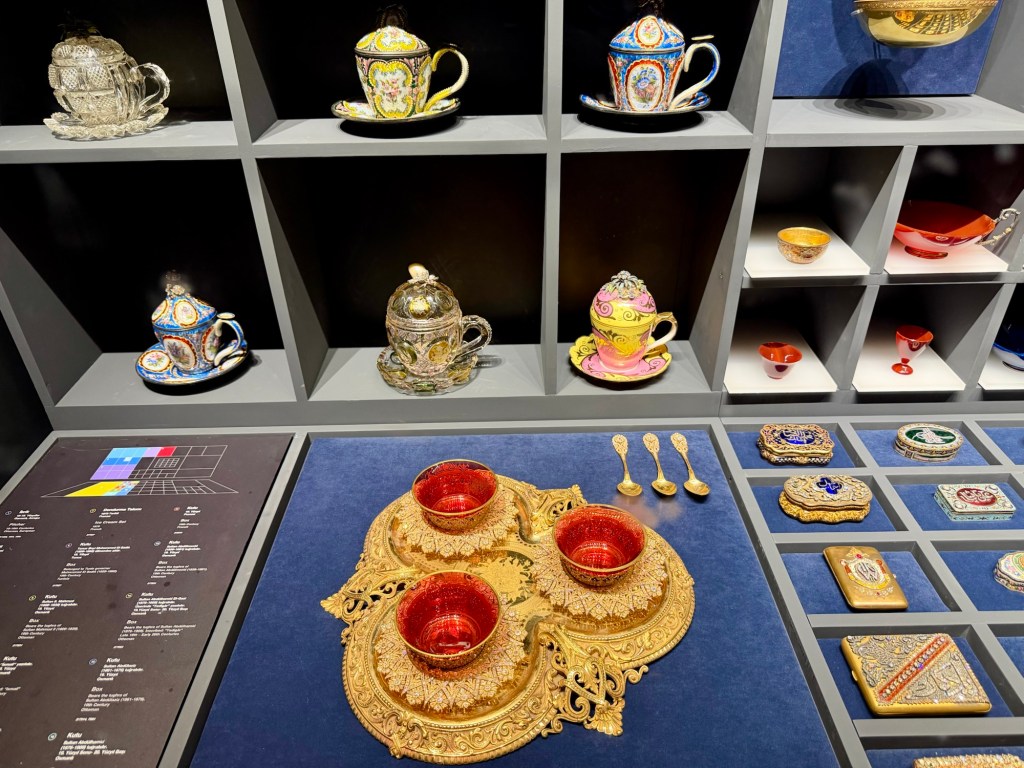
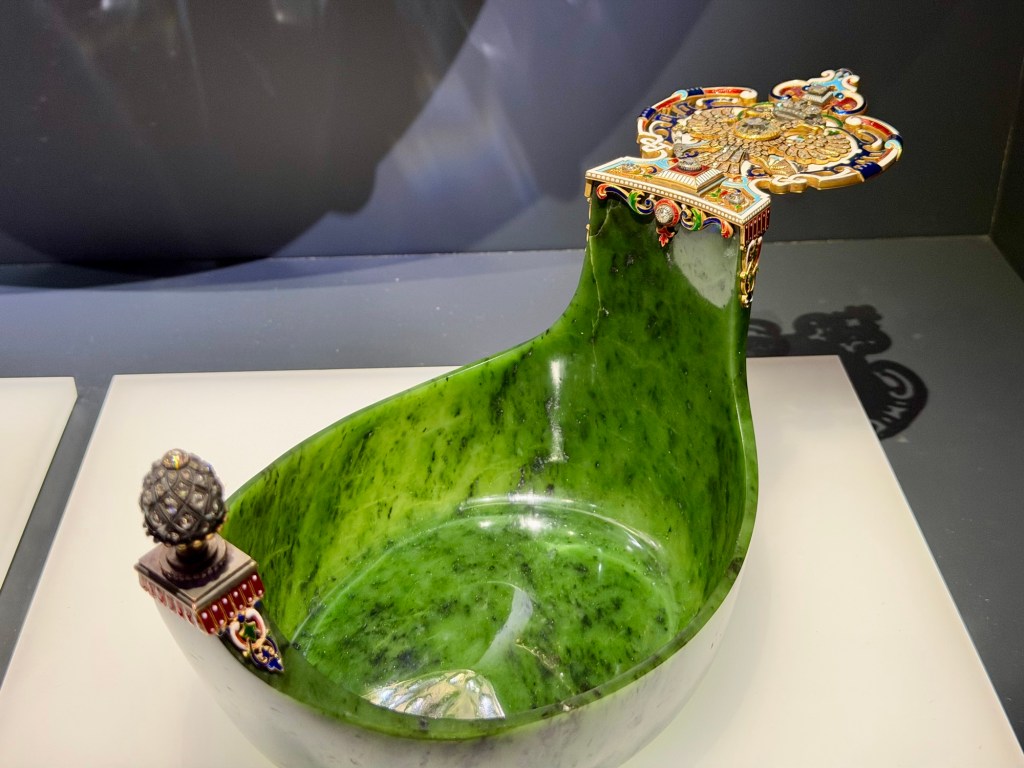
The treasury section which houses the 86 carat Spoonmakers diamond and emerald encrusted Topkapi dagger had me drooling. The amount of artefacts displayed sparkled more than a southern sky at night. Such incredibly beautiful pieces, too many to mention and rivalling the best we have seen in the UK and Russia. Quite a few of the pieces were gifts from Russia and reminded me very much of Faberge eggs. The minute details and beauty were works of art.
In the relics section they had King David’s sword, John the Baptist’s arm bone and piece of skull and apparently father Abrahams drinking stone. Also relics of the prophet Mohammed. In the church like area where they were housed there is 24 hour singing of the Quran by specially trained men. I found the singing rather beautiful and lovely spiritual energy. I did some research and there is no providence for the relics, however whether they are early replica’s or the real deal did not detract from the excitement that was palpable from Muslim and non Muslim visitors alike.
The Imperial Harem where we spent most of the time is a sprawling complex of over 400 interconnected rooms that served as the deeply guarded residential quarters for the Sultan’s mother, wives, children and the black eunuchs that guarded them.
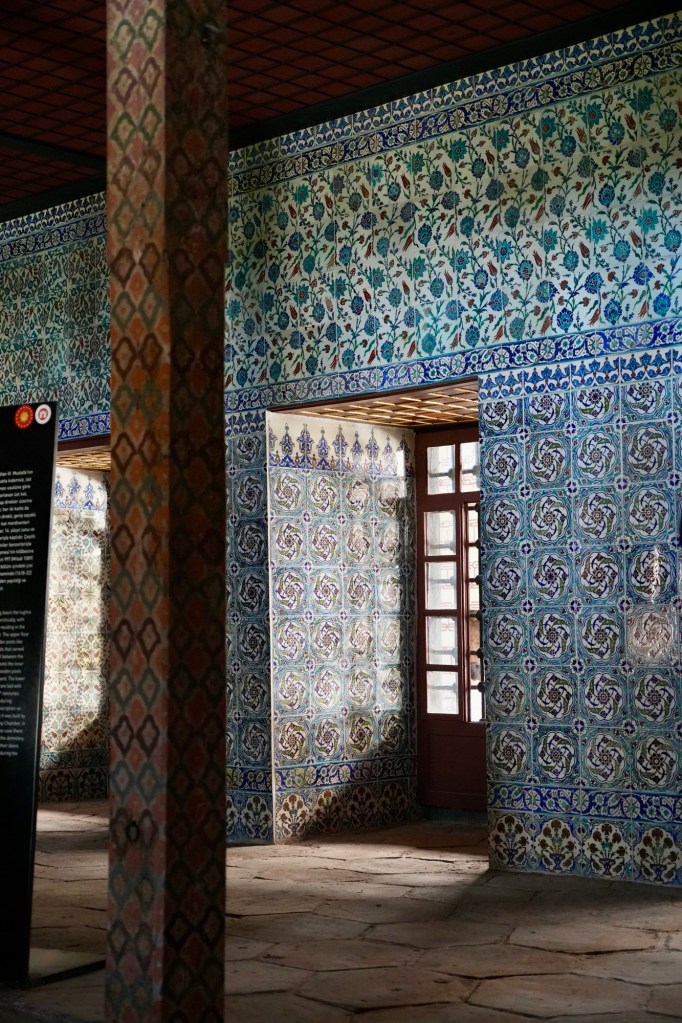
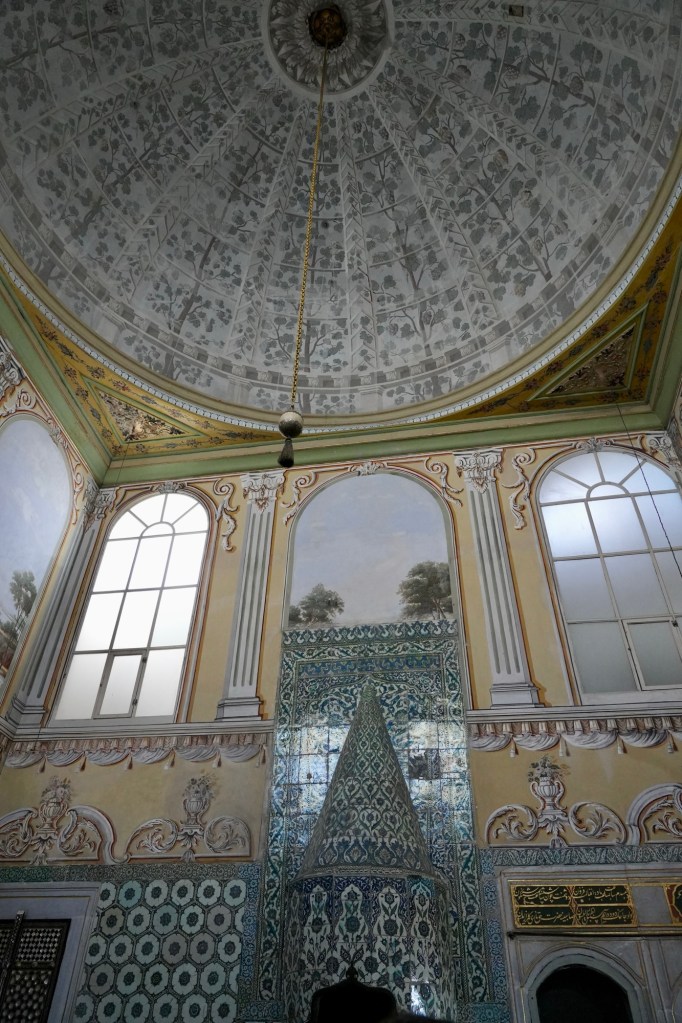
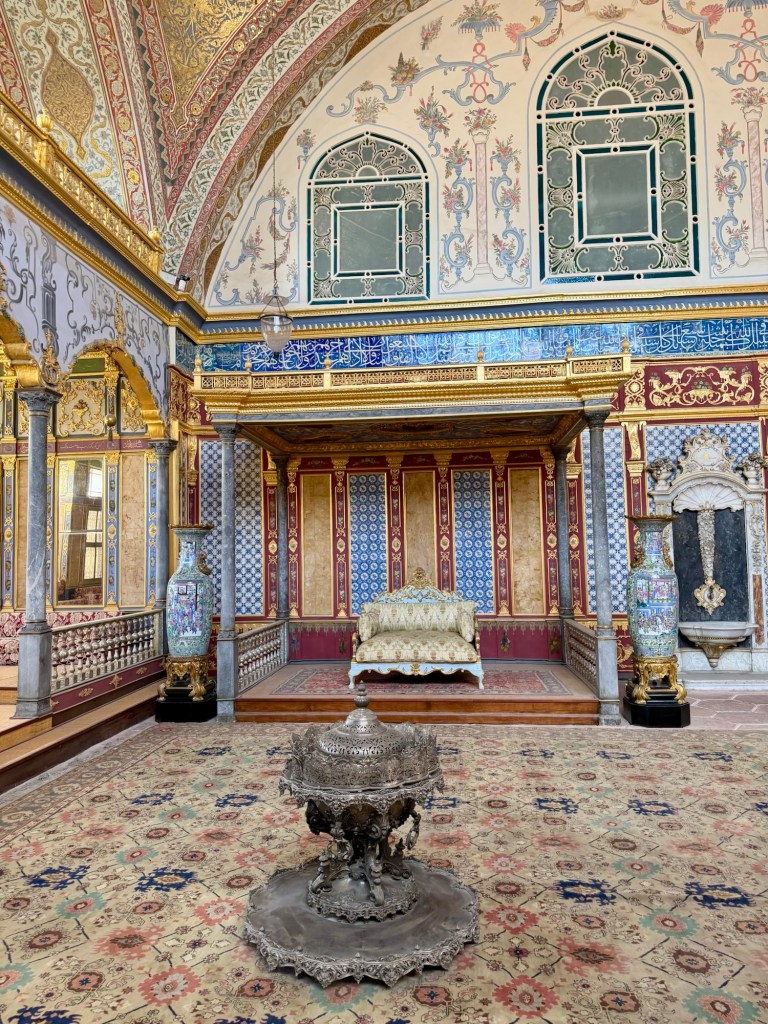
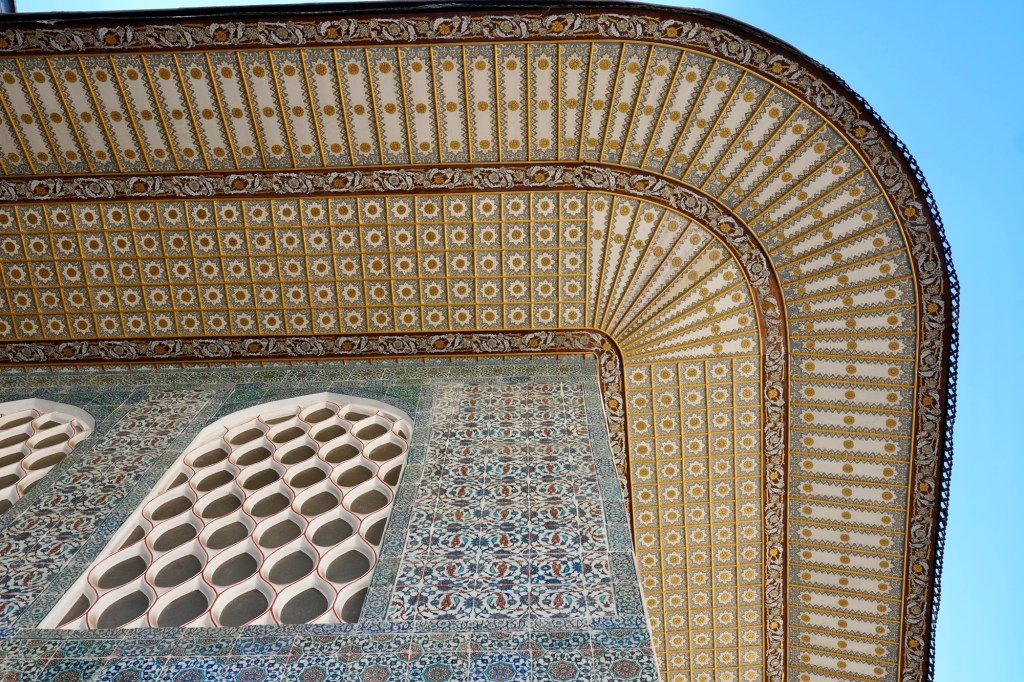
Walking through the harem you navigate narrow stone corridors, hidden courtyards, and transition from dark stone servant quarters to lavish golden light filled and tiled chambers. Most of the major wall surfaces inside the harem are covered from floor to ceiling with priceless hand painted Iznik ceramic tiles. The dominant colours are brilliant cobalt blues, turquoise, emerald greens and a rare raised tomato red. The patterns detail twisting vines, blooming tulips, carnations, and Arabic calligraphy of Quranic verses.
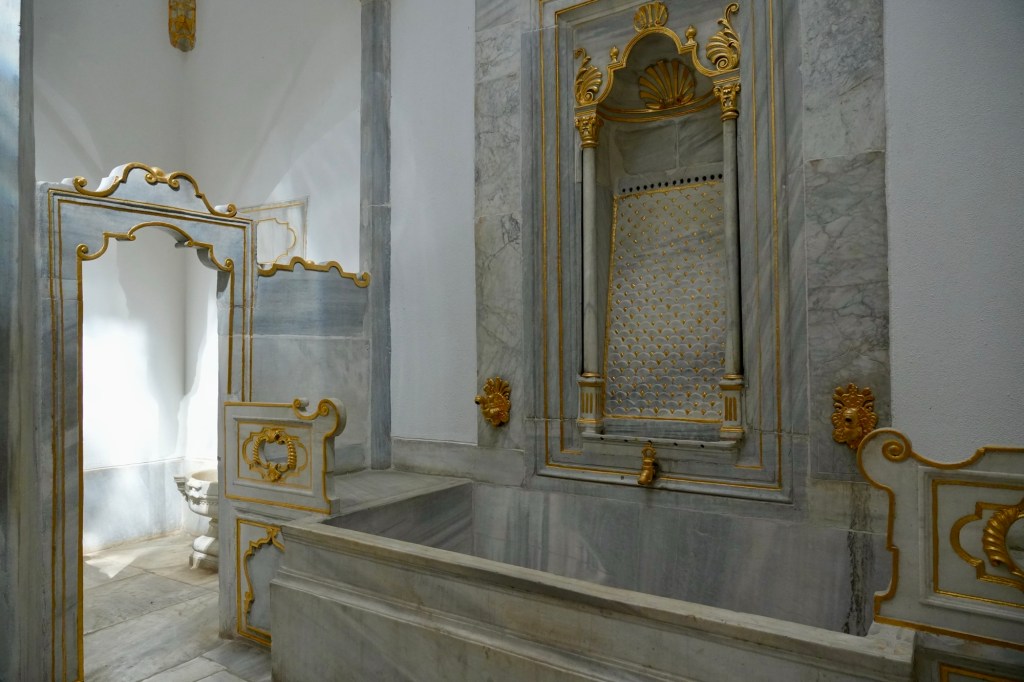
Personal cleanliness is very important to the Turkish, dating back to Ottoman times. The bath sections had haman, with piped hot water and early toilet systems (underground and in wall piping evident). Even the eunuchs had their own haman, and the King’s area was exceptionally lavish in gold with multiple cleansing areas.
I had in my mind that it may be something like the Alcazar in Seville which I absolutely loved, and some parts were similar, however it is not as grand in many respects and the focus is on maintaining what is there as a historical site, verses displaying it as it might have been or full on restoration.
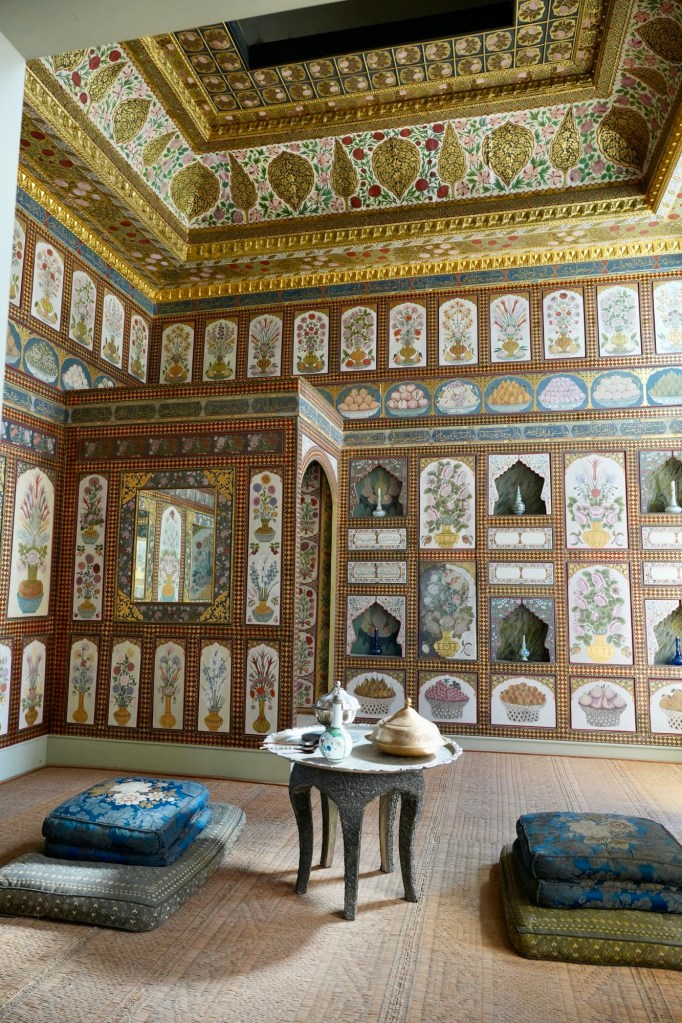
The harem was the most colourful and interesting, noting that this was not the place for concubines, but the general living quarters that the Sultan, his mother (who ran the harem). The ‘wife’ or women’s section was governed by strict rules under the Sultan’s mother. There was a hierarchy and Eunuch’s were integral to the inner circle and system.
We were occupied right up until closing time at 6:30pm and exhausted from the heat, size and hard and uneven stone path ways. We were actually beyond tired and both sore, but it was one foot after the other as we made our way down the hill to the madness of old town with the last of the palace visitors.
A note on toilets – all we could find in the palace area was one set of toilets with 3 cubicles each gender. We could not comprehend how that was meant to service the thousands of people who visit each day.
At the bottom of the palace hill we sat to rest for a minute before attempting the uphill walk in old town towards the Asian restaurant Vern had selected for dinner. We would have taken a tram, however they were crammed full with not 1cm to spare, so we did not fancy that. It was still very warm and when you are that tired you somehow manage auto pilot for a bit more. Whilst we were having our little break, a senior (probably our age) well dressed Turkish man came and sat by us and struck up a well spoken English conversation.
Long story short he had a carpet -rug shop and wondered if we were interested at a much better price than we would get at the bazaar. We politely said we were too tired to consider anything, and he was gracious and not pushy. He did add he also was tired and business very difficult. Could have been a sympathy card, but he appeared genuine.
I seem to have a different view on the people trying to sell you things and lure you into their shops these days. I see and feel that things are indeed tough – everyone is just trying to survive and make a better life, and once again I feel very blessed for our situation that we can travel and enjoy a very good standard of living in an easy country. I could not think of anything worse than living in a city like Istanbul of 16 million, in horrid appartments and few green spaces.
We dug deep and slowly went up the hill, turned right after the cistern, and up the road a bit to the Asian restaurant. We were the only ones there, which was a little concerning but the meal was wholesome, good portions and average price for that touristic area of the city. Nowhere near the standard of Asian in the southern hemisphere though.
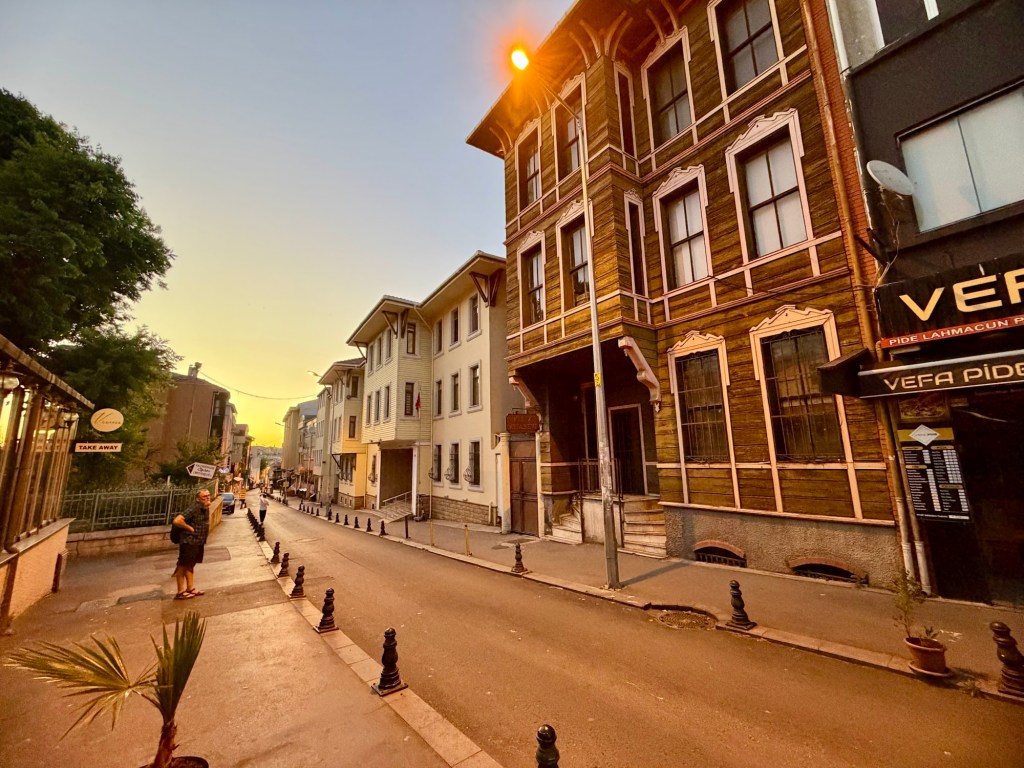
After dinner we made our way towards the tram stop to see if they were any emptier. They were not, so with a little bit of energy after a good dinner we punished ourselves and walked the 2.6km home – including some gentle hill bits. Along the way we came across a street which must have been historic with old Ottoman style wooden houses in various states of repair.
The saver was that it was now dark and the temperature was more bearable. A positive about Istanbul is that you do feel safe walking around.
11km on my phone tracker today and the satisfaction of knowing we are building our fitness and not too old for this just yet. Horizontal on the bed felt so good.


A thoroughly interesting read! Sent from my iPhone
LikeLike
thank you – I can’t wait to show you more photos
LikeLike
I was also surprised by the sheer size of Topkapi Palace and the variety of styles in its pavilions. By the end of the day, there were slightly fewer people, but I had to rush through the treasure chambers a bit too quickly for my liking.
LikeLike