 Today began with feelings of both a little sadness of leaving such a pampered and gorgeous place and fizzing excitement to be meeting the children in Venice tonight. We needed a prompt departure to fit in a trip to the archaeological museum in Bolzano to see Otzi the iceman and were at breakfast early enjoying the sun when Lili Skyped. I had to go downstairs as in public areas at the Villa you are asked not to use phones etc so as to enhance a peaceful and restoring atmosphere – which is nice. We had a quick catch up to confirm arrival details and transfers from the airport to Venice for them before we got underway.
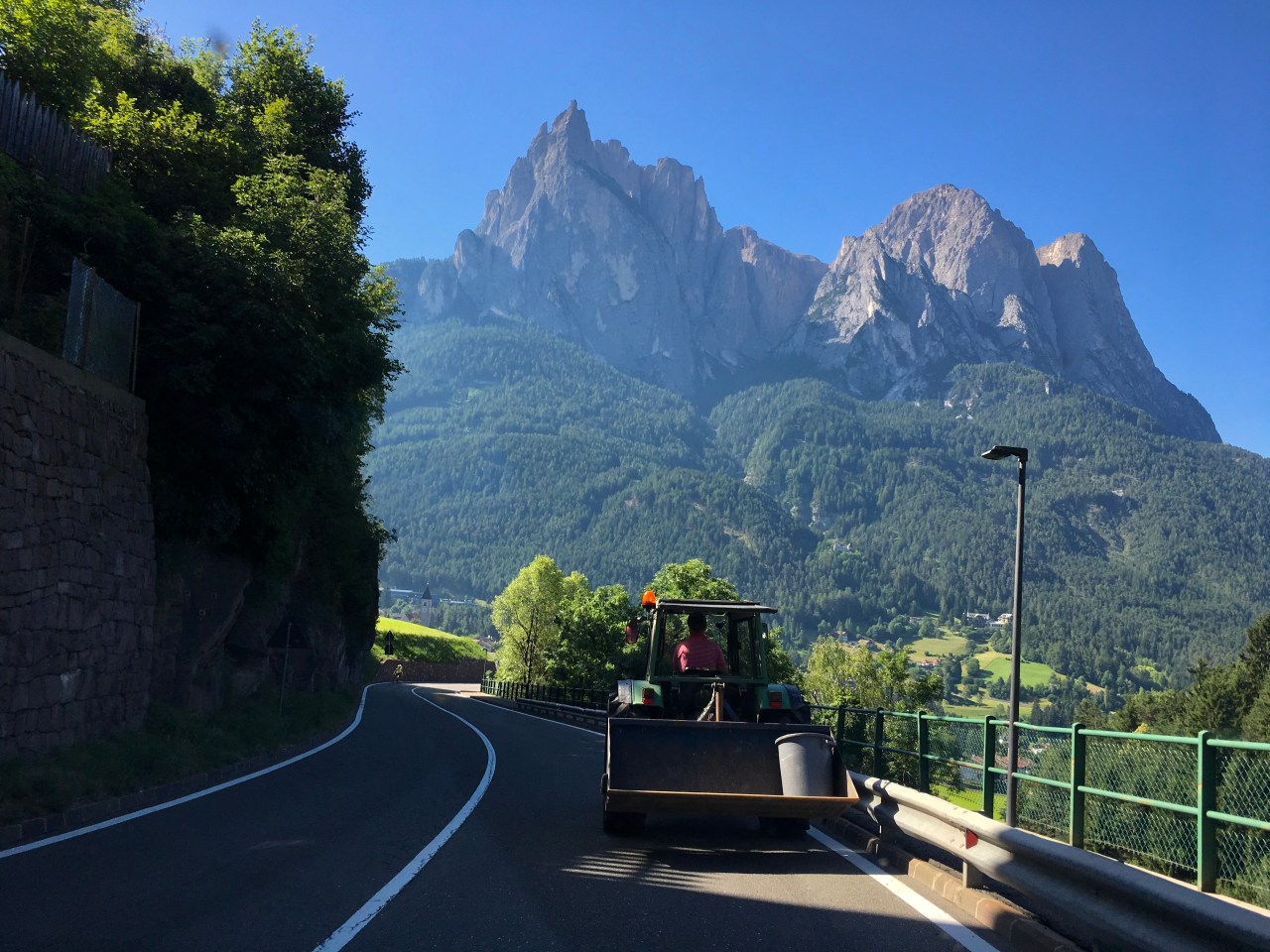
As we were driving out through the other side of Castlerotto the traffic the other way was slowed down dramatically and we soon found out why as for the next 10km we were treated to the most interesting and extensive procession of vintage and classic tractors and farm vehicles. Some of you know Vern’s first trade is with Heavy Auto Engineering and he did his apprenticeship on tractors and agricultural equipment – so he was particularly delighted and astounded at the display before his eyes – while at the same time trying to drive. I got a lot of video so he could view it later safely at leisure.
There must have been over 200 vehicles ranging from some old tiny narrow wheeled early tractors to classic semi army transporters. There would have been nothing younger than 1960’s. Every single one was shiny, polished, lovingly restored or tidy to mint original and many were decorated with flowers, ribbons, flags and wives in fancy Germanic attire and even children on wheel arches or trays and trailers.
We arrived in Bolzano or Bolzen nicely on time for the car rental’s opening and returned our final vehicle hire scratch free to a different staff member (relief). Vern has done such an amazing job with his driving, I am really proud of him coming so far, and its great to see his confidence up there now for future adventures. The Avis lady even offered to ring a taxi for us, which we gratefully accepted as we could save time and sweat by not taking a train to central and walking further again to the museum – about another 1km. The taxi cost us about less than 10 euro for a 17km drive to central where we checked out bags into storage and then got a cab outside the station for a quick and cool drive to the museum. Bag storage was expensive at 17 euro for our two suitcases which are small, and two small day back packs.
We had about 2 hours to get through the museum and back to the station with buffer time to get our bags and not miss our train. We boosted around fairly quickly missing the worst of crowds due to our early start which made it very pleasant. We both loved the visit and the display and information was well done – and in English as well as other languages. You are not allowed to take photos of Otzi or his possessions or clothes, but you can of a life size replica of what they to believe he looked like. For Otzi himself you enter a darkened area and line up for your turn a place at a window where you can see Otzi laying less than a metre away from you. He is kept in a very special environment to mimic the snow and humidity where they found him, in order to preserve his mummification. They even have an emergency plan and capsule for him in case of disaster or attack and another special room at the hospital where he can be transferred.

A lot of the excitement around Otzi is due to the type of natural mummification that has occurred in the sense that he is pretty much intact except for hair and not fully ‘dried’ – so there is a lot of information that they have been able to get from him, especially as his blood cells were perfectly preserved so it was the same as a fresh sample. It was nice to hear that they did not use invasive methods but high tech scanning, X-ray and sampling. They know so much about him such as his teeth, diseases, DNA, broken bones, last meal, age, eye colour and sight to name a few. He dates to the period around 3,100 – 3,300 BC and was found in 1991 in the Similaun Mountains by a couple of hikers. They estimate he was around 46 years old when he died, which is quite old for a man from this period. There is mystery around his death – was it murder, did he fall? He had an injury to his arm that would have caused his death from bleeding where an arrow head had pierced and there was also a fresh injury to his head. It is most likely murder – as they have also found a decorated stone used to build an alter at a church not far from where he was found that shoes an unarmed man running away being shot by an archer. This also leads to the theory that he was a man of importance.
I have copied, edited and pasted some information from Wiki that was all on display – if you are interested – if not skip the next few paragraphs but I wanted to include them as much for my interest as anything.
By current estimates, at the time of his death Ötzi was approximately 1.65 metres (5 ft 5 in) tall,weighed about 61 kilograms Analysis of Ötzi’s intestinal contents showed two meals (the last one consumed about eight hours before his death), one of chamois meat, the other of red deer and herb bread. Both were eaten with grain as well as roots and fruits. The grain from both meals was a highly processed einkorn wheat bran, quite possibly eaten in the form of bread. In the proximity of the body, and thus possibly originating from the Iceman’s provisions, chaff and grains of einkorn and barley, and seeds of flax and poppy were discovered, as well as kernels of sloes (small plumlike fruits of the blackthorn tree) and various seeds of berries growing in the wild. Analysis of the contents revealed the partly digested remains of ibex meat, confirmed by DNA analysis, suggesting he had a meal less than two hours before his death. Wheat grains were also found.
Ötzi apparently had whipworm (Trichuris trichiura), an intestinal parasite. During CT scans, it was observed that three or four of his right ribs had been cracked when he had been lying face down after death, or where the ice had crushed his body. One of his fingernails (of the two found) shows three Beau’s lines indicating he was sick three times in the six months before he died. The last incident, two months before he died, lasted about two weeks. Ötzi’s teeth showed considerable internal deterioration from cavities likely brought about by his grain-heavy, high carbohydrate diet. DNA analysis in February 2012 revealed that Ötzi was lactose intolerant, supporting the theory that lactose intolerance was still common at that time, despite the increasing spread of agriculture and dairying.
He had a total of 61 tattoos (or Soot tattoos), consisting of 19 groups of black lines ranging from 1 to 3 mm in thickness and 7 to 40 mm long. These include groups of parallel lines running along the longitudinal axis of his body and to both sides of the lumbar spine, as well as a cruciform mark behind the right knee and on the right ankle, and parallel lines around the left wrist. The greatest concentration of markings is found on his legs, which together exhibit 12 groups of lines. A microscopic examination of samples collected from these tattoos revealed that they were created from pigment manufactured out of fireplace ash or soot.
Radiological examination of Ötzi’s bones showed “age-conditioned or strain-induced degeneration” corresponding to many tattooed areas, including osteochondrosis and slight spondylosis in the lumbar spine and wear-and-tear degeneration in the knee and especially in the ankle joints. It has been speculated that these tattoos may have been related to pain relief treatments similar to acupressure or acupuncture. If so, this is at least 2,000 years before their previously known earliest use in China (c. 1000 BCE). Recent research into archaeological evidence for ancient tattooing has confirmed that Ötzi is the oldest tattooed human mummy yet discovered. We could clearly see the tattoos when viewing him.
Ötzi’s clothes were sophisticated and I found this one of the most interesting aspects of the visit. He wore a cloak made of woven grass, a coat, a belt, a pair of leggings, a loincloth and shoes, all made of leather of different skins. He also wore a bearskin cap with a leather chin strap. The shoes were waterproof and wide, seemingly designed for walking across the snow; they were constructed using bearskin for the soles, deer hide for the top panels, and a netting made of tree bark. Soft grass went around the foot and in the shoe and functioned like modern socks. The coat, belt, leggings and loincloth were constructed of vertical strips of leather sewn together with sinew. His belt had a pouch sewn to it that contained a cache of useful items: a scraper, drill, flint flake, bone awl and a dried fungus.
The shoes have since been reproduced by a Czech academic, who said that “because the shoes are actually quite complex, I’m convinced that even 5,300 years ago, people had the equivalent of a cobbler who made shoes for other people”. The reproductions were found to constitute such excellent footwear that it was reported that a Czech company offered to purchase the rights to sell them. However, a more recent hypothesis by British archaeologist Jacqui Wood says that Ötzi’s “shoes” were actually the upper part of snowshoes. According to this theory, the item currently interpreted as part of a “backpack” is actually the wood frame and netting of one snowshoe and animal hide to cover the face.
The leather loincloth and hide coat were made from sheepskin. Genetic analysis showed that the sheep species was nearer to modern domestic European sheep than to wild sheep; the items were made from the skins of at least four animals. Part of the coat was made from domesticated goat belonging to a mitochondrial haplogroup (a common female ancestor) that inhabits central Europe today.
The coat was made from several animals from two different species and was stitched together with hides available at the time.
The leggings were made from domesticated goat leather. A similar set of 6,500-year-old leggings discovered in Switzerland were made from goat leather which may indicate the goat leather was specifically chosen. Shoelaces were made from the European genetic population of cattle. The quiver was made from wild roe deer, the fur hat was made from a genetic lineage of brown bear which lives in the region today.
Other items found with the Iceman were a copper axe with a yew handle, a flint-bladed knife with an ash handle and a quiver of 14 arrows with viburnum and dogwood shafts. There was also an unfinished yew longbow that was 1.82 metres (72 in) long. In addition, among Ötzi’s possessions were berries (the berries are from a plant that is inedible at certain times, but when picked at the right time they are highly nutritious like a multivitamin), two birch bark baskets, and two species of polypore mushrooms with leather strings through them. One of these, the birch fungus, is known to have anthelmintic properties, and was probably used for medicinal purposes. The other was a type of tinder fungus, included with part of what appeared to be a complex firelighting kit. The kit featured pieces of over a dozen different plants, in addition to flint and pyrite for creating sparks.
Ötzi’s copper axe was of particular interest. The axe’s haft is 60 centimetres (24 in) long and made from carefully worked yew with a right-angled crook at the shoulder, leading to the blade. The 9.5 centimetres (3.7 in) long axe head is made of almost pure copper, produced by a combination of casting, cold forging, polishing, and sharpening. It was let into the forked end of the crook and fixed there using birch-tar and tight leather lashing. At the time, such an axe would have been a valuable possession, important both as a tool and as a status symbol for the bearer.
Genetic analysis – Multiplex assay study was able to confirm that the Iceman’s mtDNA belongs to a previously unknown European mtDNA clade with a very limited distribution among modern data sets. By autosomal DNA, Ötzi is most closely related to southern Europeans, especially to geographically isolated populations like Corsicans and Sardinians. DNA analysis also showed him at high risk of atherosclerosis and lactose intolerance, with the presence of the DNA sequence of Borrelia burgdorferi, possibly making him the earliest known human with Lyme disease. Ötzi had a higher degree of Neanderthal ancestry than modern Europeans and in October 2013, it was reported that 19 modern Tyrolean men were related to Ötzi. Scientists from the Institute of Legal Medicine at Innsbruck Medical University had analysed the DNA of 19 who shared a particular genetic mutation with the 5,300-year-old man.
So moving on from Otzi – who we viewed and paid our respects a second time before leaving – we then strolled through the town back to the station in just perfect timing to get our train to Venice. I grabbed some lunch at a cart in the park which was very good – a bratwurst with mayo, mustard and ketchup, a curry wurst (excellent) and a really tasty kebab in a thin wrap. It was only about 14 euro. We also picked up some iced tea, water and a yoghurt smoothie at a supermarket along the way so felt very organized for our total journey time of a little over 2 hrs to Venice. Our train changed with a 15 minute wait at Verona and man was it hot there. It was about 34 in Bolzen, but more like 36 in Verona. We were most appreciative of our comfortable 1st class well airconditioned coach! The scenery was a repeat of our previous journeys except the section between Verona and Venice. This one we had done in 2013 and Vern got nicely excited as we hit the lagoon on approach. Even though you cant swim here, its really nice to be near the water again.
It didn’t take too long to find our check in spot, but the short walk left us nice and sweaty – again! There seems to be heaps of tourists about – pretty much wall to wall and all looking hot and bothered. The weather pretty much looks the same for the next two days – 32-34 all the way. This of course feels a lot hotter inbetween the buildings, even in the shade due to lack of cooling breezes and airflow. We have booked an upper range Air B&B apartment with two rooms on the Grand Canal as a treat for the children. Its always a bit of an anxious moment until you get to see what you have booked on the internet but I was relieved to find it looked just like the pictures and had air conditioning units in every room. We also have a washing machine and full kitchen, and two bathrooms complete with bidet in each. Yippee.
Our room looks out on the canal on both sides, and is nice and roomy and decorated in a typical Venetian old style complete with chandeliers – its just the atmosphere I was hoping for and I am excited and delighted to share this with Hugo and Lili as part of their first and only taste of Italy on their trip. They were due to arrive in at 11pm and then get a vaporetto (water bus) to the island which takes about 40 minutes but Lili messaged to say their plane from Geneva was delayed and would message again on departure and arrival. No worries – we said we would meet them at the bus stop on this side as its too much like a rabbit warren for the new comer to navigate easily.
So we settled in and then went to a supermarket round the corner which used to be a theatre and still has gorgeous balconies up the top. I got excited again at the lovely produce – huge red lettuce, gigantic eggplant the size of small rockmelons, tomatoes begging to be eaten and stunning sweet crisp and juicy spring onions the size of mandarins – just to mention a few. We got some nice fruit, yoghurts and cereal for some breakfast supplies and after a little rest headed out for dinner as we were starving again. Vern navigated us round some backstreets to an area our host recommended and we found a nice average priced and cheerful place to eat that advertised air conditioning inside. Well that wasn’t quite the case but the food was good and not overly expensive for Venice. I had a seafood pasta and Vern had a carbonara. Both were nice but not fabulous – I make a better carbonara.
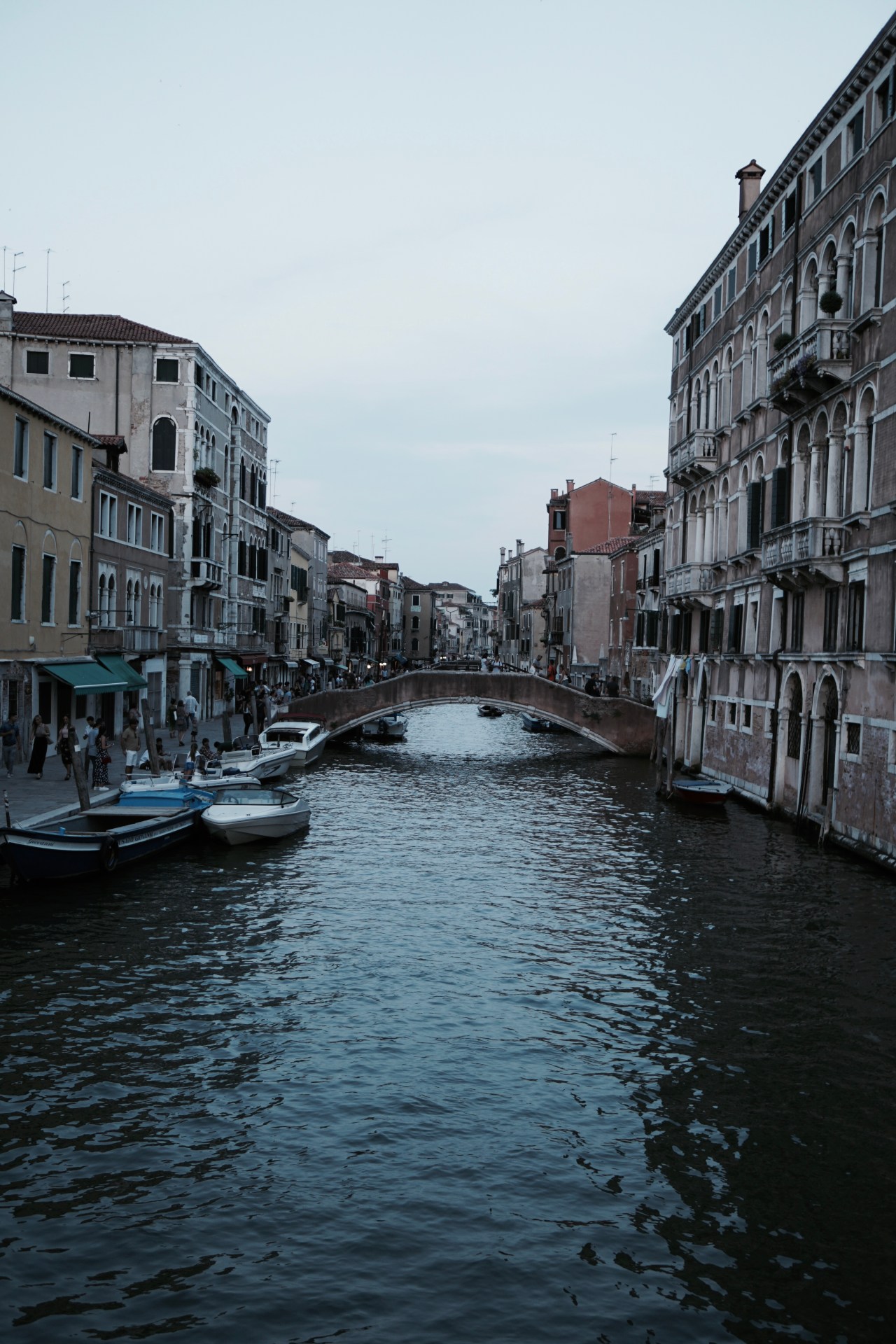
We strolled home in the dark already clicking into the pulse and romance that is unique to Venice. How does one describe the this old crowded, shabby, leaning and uneven vehicleless water city? Its hot, does smell a bit in places, is expensive, over crowded, noisy, and touristy BUT if you put blinkers on to that side you have Italian romance at its unabashed finest. It is just quintessential Italy on water.
We heard from the kids that they arrived in a little after 12 which meant they could catch the 12:40 vaporetto having them arrive at 1:10am at a stop on the north side of the island a 20 minute walk from us. At about 11:30 Vern was looking out the window and then I heard a “wow that was a good one”. And then again – there was a terrific lightening storm and it had started to rain and thunder and so it continued for the next hour! We have not been in such a long and energetic lightning storm ever – there were sheets and forks that branched into 4 strands as it hit the ground. The illumination of the old city was superb taking you back to early days where there was no electricity and life was a different.
Now sense would have one look for an alternative to meeting the children but this is Venice and there is none, so we cheerfully put our mac’s on, grabbed an umbrella and headed out into the music of the electric night. After all it was warm and what’s a bit of water in exchange for stepping out or stepping back in time into such an atmosphere like Phantom of the Opera or Les Miserable – you couldn’t pay for an experience like that! Due to the rain which was stopping and starting – we didnt take the ipad so only had a small tourist map and street light to navigate the streets, lanes, alley ways and canal bridges. We knew the general direction and got there in good time to pop out on the waterfront to an empty pier except for two figures under an umbrella in the distance. It was so exciting to see them, and so surreal. We met in the middle and hugged and laughed at how crazy this all was – and how incredibly theatrical and wonderful.
Needless to say this was a most unforgettable entry and introduction to Venice for Hugo and Lili and despite the rain and the dark their eyes were wide open with wonder at the Renaissance city in the quiet early hours of the morning, highlighted by the still frequent lightening flashes and ripples of thunder. The lightening made statues and gargoyle spouts come alive and puddles reflected the orange yellow glow of the old glass and wrought iron lamps. It was a very late night but so very worth it and none of us would have had it any other way.


 Travels with Valrock