We were greeted warmly by Lauren and climbed into our Landrover Defender – this time in the back. They have a frame and roll up canvas roof, so you can stand up and view safari style. This also gives a very good thigh and butt work out – like doing squats – as I found later in the day. Still the heatwave remains, and in fact increases every day by a degree – which believe it or not you do feel once you are over 32 degrees in my opinion – so 38 degrees is the high for today. The mornings start off around the early to mid twenty’ with mild humidity around 35% and a light grey heat haze. This starts to burn off by about 11am and by 12pm its a blazing blue and peak temperature is around 2pm and it pretty much stays up there till 8pm, where the temperature may drop a bit, however the humidity is around th 50’s. Our other guests today included a mature Dutch female pair, and two mature American friends – the male who had rented a house for 2 months and was inviting friends over for a couple a weeks at a time. Whilst there was nothing wrong with the new roomies, we missed Scott and Susie and the more intimate trip vibe from yesterday.
We headed west again, but in a southerly direction and to my absolute delight it wasn’t long before Lauren pulled over on a back road by a sunflower field and allowed us to hop out and get our photos up close and personal. Tick – another bucket list item – face to face with a happy golden sunflower in Provence. Simple as it may sound but this was a thrill for me as it fulfilled a romantic ideal of summer in Provence of big fields of clear golden yellow flowers tilting their oversized heads towards the sun in expectant unison contrasting with white washed farmers houses and green French Cyprus.
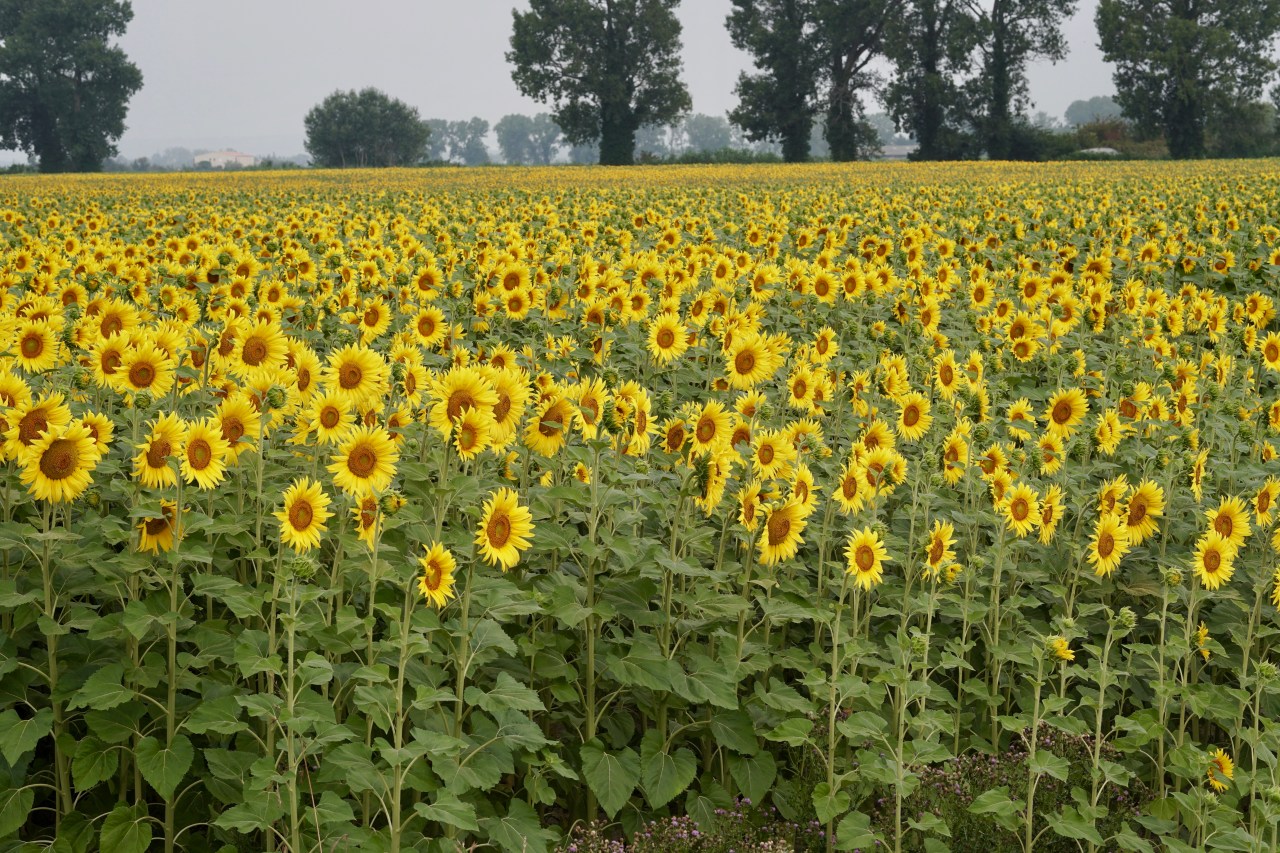
The scenery around this former marsh land is dominated by 13,000 hectares of rice. There used to be up to 20,000 but not since the European Union cut subsidies. Other key crops are wheat, sorghum, sunflower for feed not oil, and barley. We saw that apples such as Jazz grown under Enzo’s label, and a lot of other fruits like apricots, strawberries and pears are sold at the gate. There is a lot of espalliered trees – pip fruit I presume.
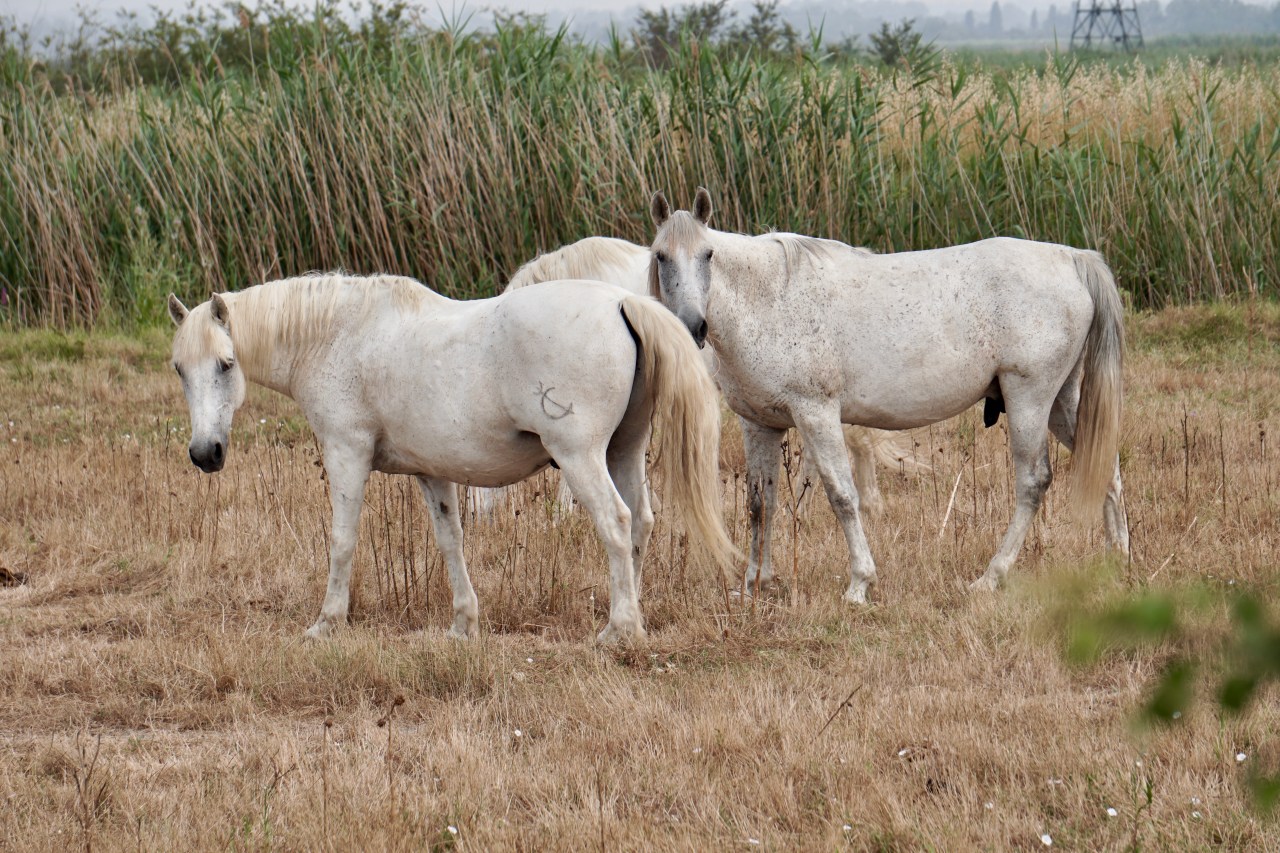
Lauren pointed out a lot of migratory birds that go both north like stalks or other colourful small birds that return to Africa. We got to see native Carmague horses – which despite all the photos of them running and splashing in the salt marshes, are not wild. They are all owned, branded, and allowed to roam in the national park – much like the wild horses in Englands New Forest. They are large slightly stocky pony size – being under 16hh, and are actually classed as grey, even though referred to as white. The foals are born various shades of brown – to nearly black and slowly gain the grey -white colour by age of two. If you look at the photos of the horses closely you can see they keep a black skin, so this makes the white appear grey. 80% are not shod as the salty hard flats doesn’t require it. Stallions are generally ridden by men for bull work, a bit of chauvinism exists in this regard according to Lauren, albeit she personally is not phased by it and rides what she wishes! As in the Alpine region, around 100,000 Merino sheep are grown here in winter and go to Pyrenees’s in summer.
The rice grown here is reputed to be very good due to the rich sea mineral soil. Crops are rotated every 2 yrs with sunflower as rice takes a lot out of the ground. Irrigation is used heavily and modern and very old irrigation canals support the wet environment required by the grain. Each kilo of rice requires 3,000 liters of water! Various colors is grown including the prized slightly nutty flavoured red -which they consider best in the world (of course). The red is usually blended for sale with other colors as not as productive as the white or brown crops.
Another point we were not aware of was that this area is the starting point for the el. Camino walk that goes right to the north west coast of Spain.- although not in summer months due to the heat. Private houses provide free bed – stop off places for pilgrims or walkers and these are indicated by scallop shells on gate posts. Also mosquitos were quite bad here, and the amount of chemical needed to control them was not desired or sustainable so now they breed and release dragon flies to manage them. A Dragon fly eats around 300 mosquito larvae a day.
The Camargue bull is said to be most like prehistoric bulls of any breed, as indicated by its long body shape. It is not particularly large by bull standards, is mainly black, and differs from the slightly larger Spanish bull by the direction of its horns which curl up vertically from the head, verses the Spanish which curl forwards. A note on bull fighting which is very popular in France, they use ribbons for tagging the horns and the fighter needs to remove the ribbons. There is no stabbing or blood and bulls are the hero’s, not matadors. When a successful bull retires it is allowed to live out its life in comfort – never goes to the table. Of course other beef is grown for plate. We briefly called into a bull farm and saw their practice arena and a group of staff ready to go out and train. They have distinct saddles here – high back and fronts.
As we got closer to the Mediterranean we stopped for a 30 minute break at a town called Saint Marie de la Mer. It had a very different feel to any other French town we have been in – very Spanish white washed look, bull statues, arena and pictures, a local Paella and gypsies trying to sell lavender or amulets. We looked for a rest room break by the water and the first one smelt so bad we couldn’t do it, so went a bit further and found another which was normally pay, but broken – all it required was a person to stand guard at the door – sorted. A nice French lady tipped us off for that and we obliged by guarding the door whilst she used the facility. Further into town we got a quick, delicious and cost effective snack of anchovy pizza – again and a goats cheese and jamon for Vern and some more liquids. Vern has become addicted to nice cold iced tea – peach flavour or tropical if we can find it.
After leaving St. Marie, we entered the natural park area which is a mixture of wetland and dry areas – and flamingo territory. We paused at a pull off area at one point and got our first view of the native flamingo that migrate here for breeding. They are not the bright pink but a pale apricot with vibrant orange under their wing. I was excited to see them, but the reality of the distance and my limited zoom meant I couldn’t get a postcard picture. I understand that – again the compromise of travel equipment and the fact of being in the wild and observing free birds. For a closeup, one can always go to a bird park or zoo. At one point a big flock took off and flew overhead – too fast for a pic, but an amazing experience. After about 30 minutes of slow bumpy 4×4 through the park we headed home.
My thoughts of this trip are that it was not as good as yesterday – as the scope of variety was not quite the same. I had hoped – perhaps idealistically to get closer to flamingoes and that was not to be. I am still pleased we went on both tours though as we have seen and learnt so much that we would never have had the opportunity if we had gone solo especially with our short time here. Lauren was just a treasure, and made it so memorable and valuable. We have had such a great overview of the Languedoc and Provence region I would do it again without hesitation.
Today on return we had a good plan in place, firstly a cool shower and refresh in the airconditioning before a walk to the station and our pre booked seats in reasonable airconditioned comfort for the short 15 minute ride up the line to Nimes. It really wasn’t the weather for walking around the sheltered stone city, but it was our last day here and opportunity to see the place where denim was created, and one of the best restored Greek temples in Europe. Nimes was founded 2,000 years ago and respresents one of the most important colonies of the Roman world both is size and population. It was located at a commercial and cultural crossroads and reached its apogee (highest point of development) at the time of the Emperor Augustus. It was at this time some of the significant monuments that can still be seen today were built, such as the aqueducts, temples and forum.
Arriving at the station you walk out to a tree lined waterway heading towards the old town and artifacts. Despite having cooled for a bit it at our home and on the train (the walk from home to train station of 10 minutes warms you up) it doesn’t take long in 38 degrees to feel hot – so we paused for a bit and did what the locals were doing and cooled our feet in the shaded water feature – it was very nice to say the least – if only I could have been like a kid and laid down in it!
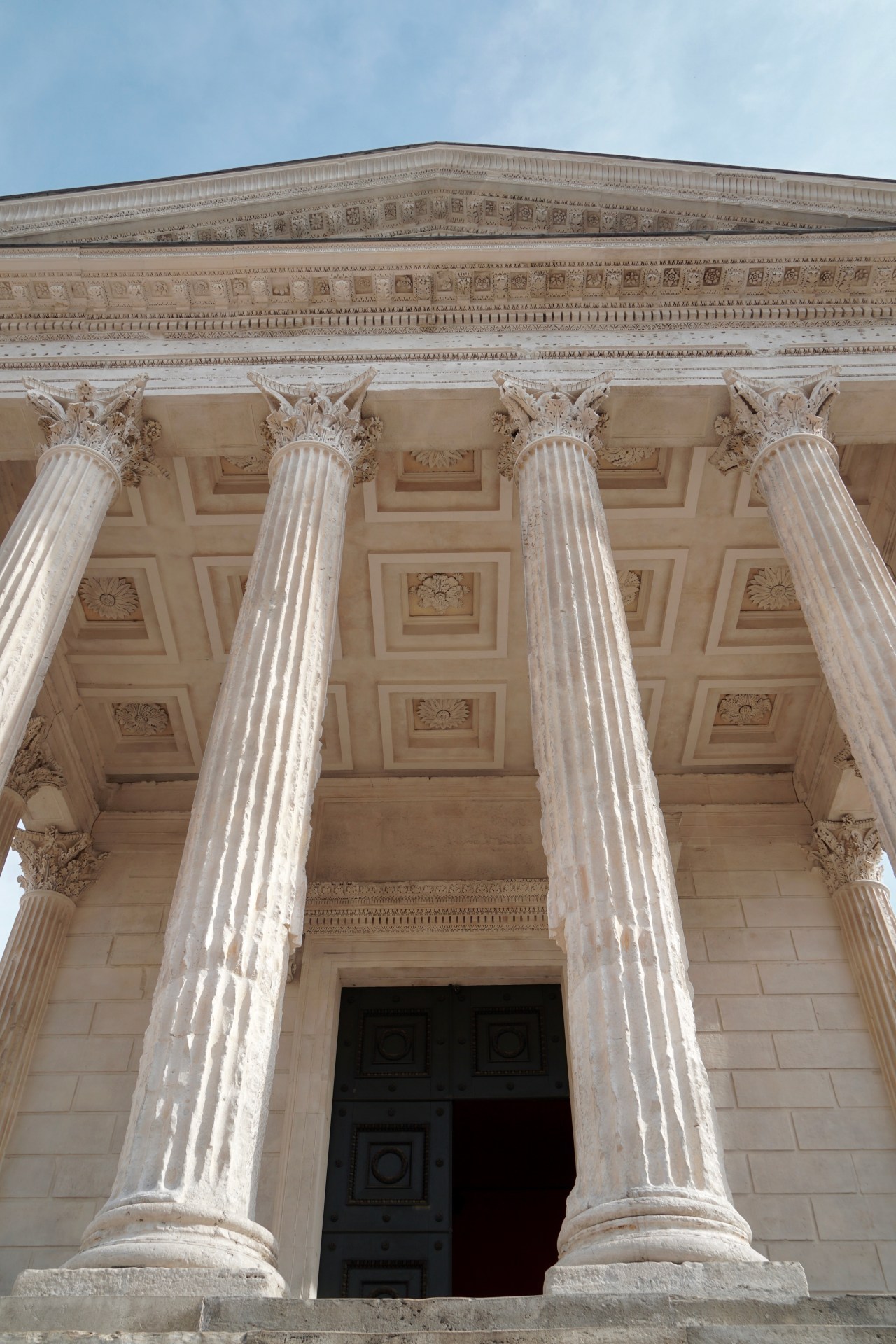
We had google mapped the sights and made our way slowly through town, drinking lots of water and enjoying the scenery. Nimes is a lot more modern – despite the antiquities – than Arles. Streets are wider, buildings are taller and it has a more light an airy feel by comparison. They have a focus on restoration so the shabby chic look is not so evident! Along the way we tested the soft serve and can give that the tick – twist flavours of chocoate and pistachio and raspberry and vanilla. The first building was a justice hall built with Roman temple style entry in the 1800’s – its impressiveness was in its condition and size. Next we cam across the Temple – or Mason Carree built in the 1st century for adopted grandsons of Augustus. Set amongst a forum, only the priests could go inside, but the public could enter the front part. It has undergone extensive restoration over the years and is very impressive in its size measuring 26 x 23m and decorative nature. As you can see by the photos – I love the artistic ability and decoration of the stone workers so long ago – I fascinate how the got it so beautiful and high. Inside the building they show a film on the history of Nimes, but there is no original features so we did not go inside – also time was tight before our return train.
Following the temple we walked a further 10 minutes to the ‘Jardins de la Fontaine’ which are public gardens first set out in the late 1700’s near the sight of a spring, and Roman thermal baths. For risk of being boring I have to restate how hot it was – but we battled on and walked around the gardens, up stairs to a view point, rested in ‘shade’ and then made our constantly slick with sweat bodies take one step at a time back towards the station for our train at 19:00. It was so hot again I was having trouble taking pictures as it required a level of concentration the heat was taking away from me. Even walking was something to hyper concentrate on – steps at times felt stumbling and we are always conscious of not wanting to fall and injure ourselves which is so easily done. As fast as we hydrated ourselves we seemed to leak it out! On route we downed another 1.5l bottle of water within 15 minutes. We had about half an hour up our sleeves so we took our shoes off and tried to normalize in the water feature again. I am a bit vain about photos, but am happy to post the one here that shows the stress on the face from this heat. In saying all of this, however unpleasant and hard going the heat has made this holiday – it forms part of the many unforgettable experiences and memories of the trip.
When we got back to Nimes we headed home via the supermarket to grab some supplies for a picnic dinner in the airconditioning of our room. We didnt have much time before closing and whilst I was trying to choose my wine one of the workers was chasing up customers. He was very nice about it and was with Vernon when I appeared a bit hurriedly in the rear championing a bottle in hand – he broke into a big smile, and nodded and shrugged in knowing and approval – yes the wine!
A big day today – lots seen and experienced. We have really enjoyed our tours, strolling, and overall time in Arles. Nimes was worth a visit and if one wanted to come back and view both and explore the full breadth of history, culture, art and scenery in the towns/cities and surrounding countryside you could easily spend 10 days here or more. I am also pleased – after my initial mild shock – that we chose Arles verses Nimes for its more intimate character and smaller size. We had originally booked Nimes but our accommodation fell through (Air B&B) so we rethought and re investigated things and changed venues.


 Travels with Valrock